01
Wharton Global High School Investment Competition · Team Asgard Assets
A portfolio that had to do more than grow
The case asked one portfolio to do four jobs: grow $500,000 toward $1.5 million in ten years, pay out $10,000 a year from year three, support a foundation’s neighborhood work, and hold up when markets fall. Four of us built it.
One portfolio, four jobs
Each job pulled the portfolio a different way. Pick one to see which part of it was doing the work.
- Stocks and one ETF · about 81%
- Two Treasuries · about 17%
- Cash · about 2%
-
Turning $500,000 into $1.5 million in ten years, with withdrawals along the way, meant a return the report put at about 12.5% a year. Stocks were the engine, led by semiconductor and software names such as AMD, KLA, Adobe, Salesforce and Oracle.
-
From year three, $10,000 leaves the account every year. About 2% in cash, plus the shorter of the two Treasuries, kept the portfolio liquid for the withdrawals.
-
The foundation works on neighborhood parks, courts and fields. The team scored companies on community impact (40%), local ties (35%) and sustainability (25%), and tilted the stock mix toward health, housing and water: Welltower, UMH Properties, Dexcom and a water ETF.
-
About 17% sat in two U.S. Treasuries, a hedge in case the stock market sold off.
Allocation from the team’s final report. A contest case from late 2025, not investment advice.
Why a REIT isn’t judged like a software company
My part was the company-level quantitative research. One thing it had to get right: different companies need different yardsticks. For real-estate investment trusts (REITs), the team compared how fast their existing properties were growing and what the market paid per dollar of funds from operations (P/FFO), rather than pushing every company through one valuation measure.
| REIT | Same-property income growth | Price / FFO | Dividend yield | Debt / equity |
|---|---|---|---|---|
| UMH | 12.0% | 17.29× | 5.76% | 0.73 |
| WELL | 14.5% | 44.82× | 1.44% | 0.47 |
| REG | 4.8% | 15.99× | 4.16% | 0.81 |
The rule we wrote down: REG was the bar. Any REIT had to beat it on growth, or show a clear advantage on price, to earn a place in the portfolio.
UMH cleared it on growth, 12.0% against 4.8%, at a price only a little above REG’s and with the best dividend yield of the three. WELL cost far more, at 44.82 times FFO, but grew fastest and carried the least debt.
From the team’s final report, p. 8. Contest analysis, late 2025.
The trade the team chose
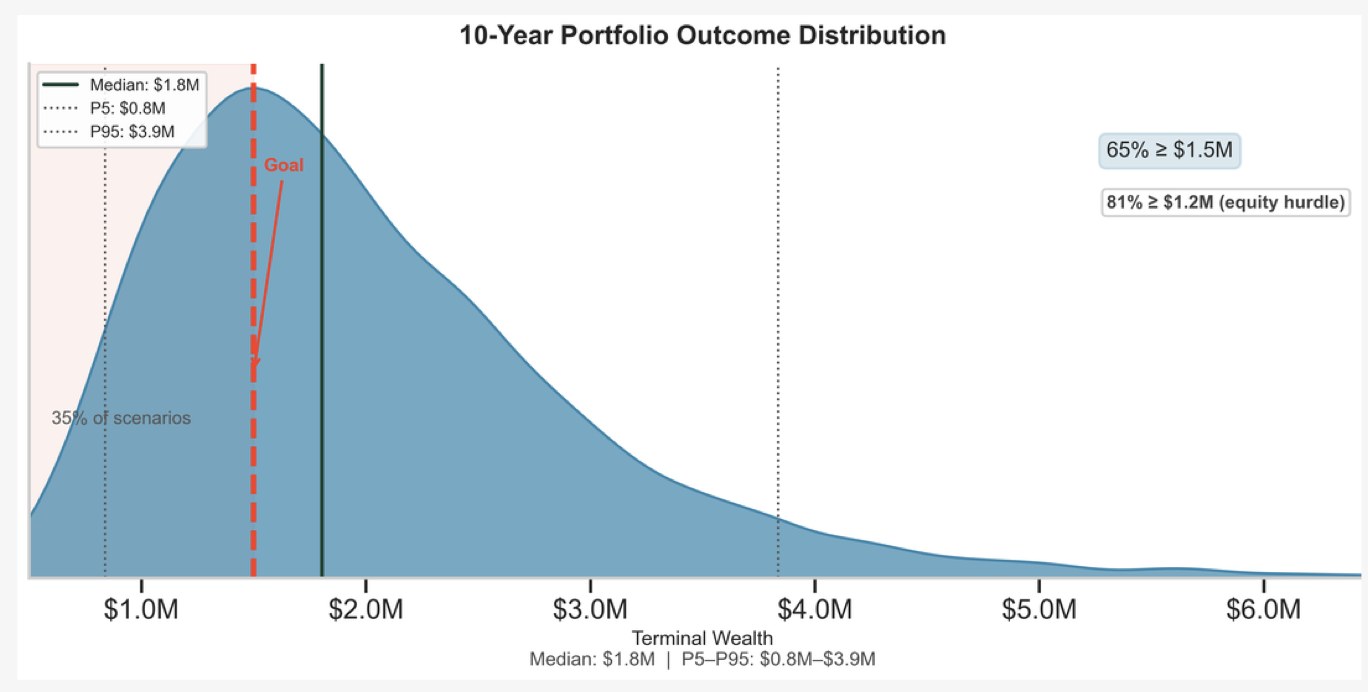
The team then asked what the portfolio would do over ten years. In its simulation, a purely financial optimization reached about 99% success, but only by dropping the companies that fit the foundation’s mission. The team accepted a lower success rate instead.
Across 10,000 simulated ten-year paths, about 65% reached the full $1.5 million and about 81% cleared a $1.2 million hurdle. The median path ended near $1.8 million, and 5% of paths ended below about $0.8 million.
The simulation itself was my teammates’ work.
 (opens the image full size in a new tab)
Two Treasuries, two jobs
Due February 2031
5.475% coupon
The shorter bond. It kept the portfolio liquid for the withdrawals.
Due February 2036
4.5% coupon
The longer bond. It lines up with the foundation’s 2036 flagship project and locks in long-term income.
Together their duration sits close to an intermediate-term Treasury fund, which kept price swings in check. From the final report, p. 13.
My part
- Company-level quantitative research: the valuation, leverage and cash-flow work behind the stock picks.
- Proposals for the major allocation, and the stock and bond selection.
- The design of the final report and the pitch.
Teammates led the qualitative analysis and backtesting, and ran the simulation.